NACBA ABLI 2026
Pre-Packaged Private Student Loan Adversaries
A Systematized, High-ROI Litigation Model for Consumer Bankruptcy Attorneys
Stanley Tate
Tate Esq LLC · 2026

Before we begin
"You have closed files sitting in your system right now."
By the end of this session, I'll show you a three-step search to find them.
Part 1 · 0:00 – 5:00
The Bridge
The landscape has changed. The problem isn't the law.
The real problem isn't the law.
What you believed
- Case law was stacked against you
- Couldn't identify who to sue
- Feared being bled out in discovery
- Couldn't predict the outcome
The actual problem
- Filing without screening
- Filing without modeling
- Filing without operational discipline
- Treating PSL adversaries as chaotic
Private student loan adversaries only become unpredictable when you file them without structure.
The landscape has changed
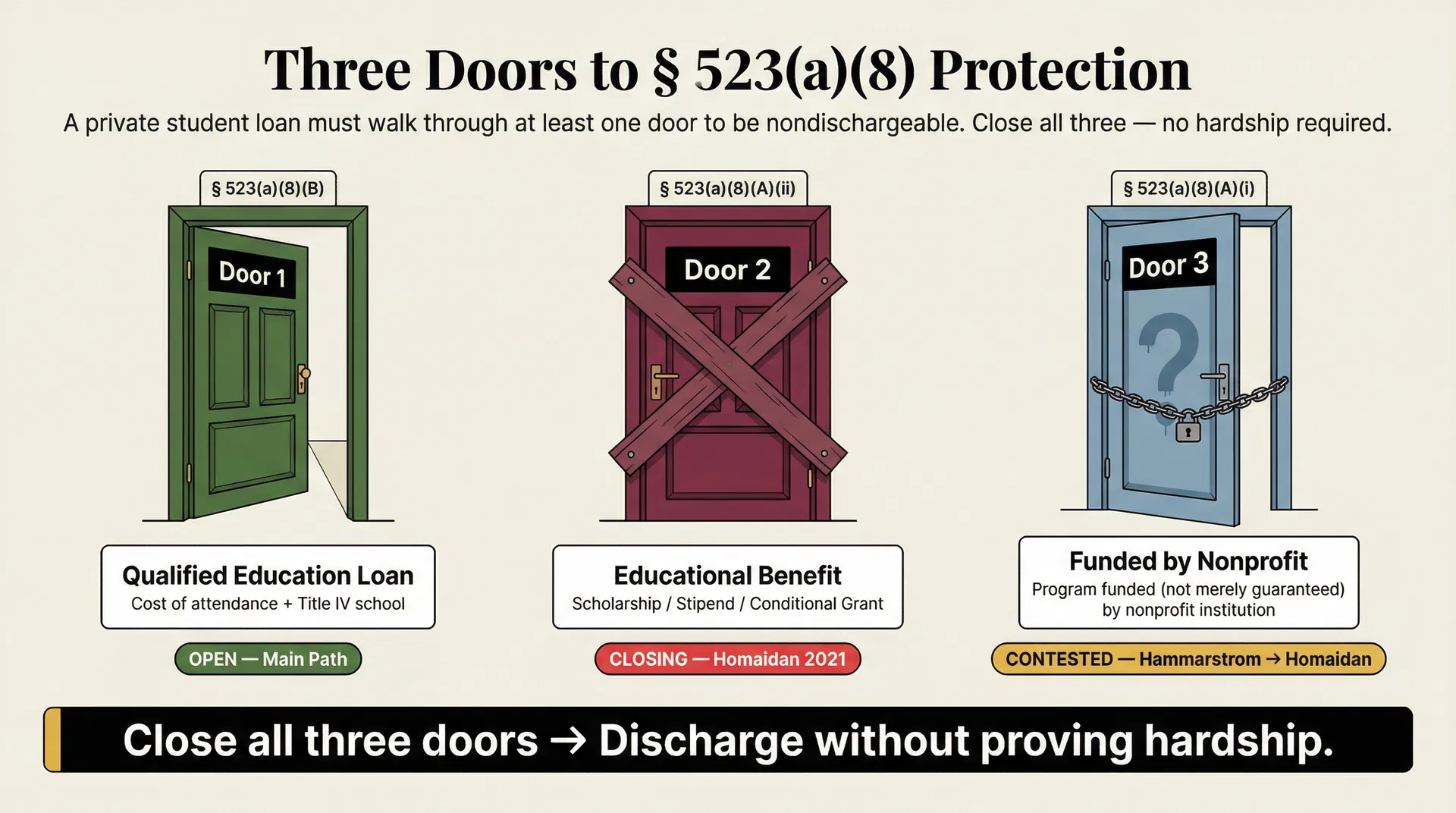
Three things have shifted in your favor.
1
The "back door" is closed.
Homaidan v. Sallie Mae (2d Cir. 2021) — "Educational benefit" covers only conditional grants like scholarships. Not commercial loans.
2
The front door has a roadmap.
Mazloom, Golden — a framework for challenging whether a loan was ever protected under § 523(a)(8) to begin with.
3
The hardship standard is shifting.
Rosen v. Trellis (W.D. Va. 2025) — The standard is the ability to repay the loan, not make nominal payments. Private lenders have no IDR. No forgiveness.
Rosen v. Texas Guaranteed Student Loan Corp. (Trellis) · Bankr. W.D. Va. · March 2025
"§ 523 does not require efforts to make nominal payments that will never retire the debt."
Judge Connolly · Bankr. W.D. Va. · Adv. P. No. 24-06016
The standard is the ability to repay the loan. Private lenders have no income-driven repayment. No forgiveness programs. That is a fundamentally different question.
Part 2 · 5:00 – 20:00
The Pre-Packaging System
Every case moves through gates before a complaint is drafted.
The specialist frame
"This is how you stop being a commodity and start operating as a specialist."
Every case moves through a series of gates before a complaint is ever drafted.
The Pre-Packaging System
Five gates. Every case. No exceptions.
Gate 1
NEED
Should this adversary exist?
›
Gate 2
VALUE
Is there a realistic resolution zone?
›
Gate 3
WEIGHT
Is this operationally survivable?
›
Gate 4
LEVERAGE
How uncomfortable does this become if litigated?
›
Gate 5
CONTROL
Are you structuring predictability?
If a case cannot pass all five gates, it does not get filed.
Gate 1 — Need & Value
Should this case even exist?
Kill the case if…
- A realistic non-bankruptcy solution exists
- No plausible resolution band before filing
- Lender identity is unconfirmed
- Settlement feasibility not modeled
File if…
- No viable non-bankruptcy alternative
- Lender / servicer / trust confirmed
- Settlement feasibility modeled
- Resolution band defined before filing
Most cases should be killed at intake. That is the discipline.
Gate 3 — Weight
Can your firm survive this case?
Count the multipliers
- Number of lenders
- Number of loans
- Cosigner entanglement
- Discovery volume
- Competing legal pathways
Fee range
$2,000 – $20,000+
depending on multipliers
"If your fee cannot survive six months of motion practice, decline the case. You are a specialist. Price like one."
Case Story
Seven lenders.
Forty-three loans.
Four adversary proceedings.
Forty-three loans.
Four adversary proceedings.
Five private lenders. Two federal. Three legal pathways running simultaneously.
Fee: $20,000 · Results under NDA.
CONTROL in practice
Draft every complaint for default judgment.
If the party doesn't show up, the judge should be able to rule in your favor without a second evidentiary hearing.
Complete factual record
Every fact needed for judgment is in the complaint itself.
Documentation pre-assembled
Evidence gathered and organized before the complaint is drafted.
Legal theory self-contained
The theory of discharge is fully articulated — no development needed in discovery.
Gates 4 & 5 — Leverage & Control
How do you build pressure and maintain it?
Leverage comes from
- Hardship density — documented, not aspirational
- Origination defects in the loan
- Cost-of-attendance violations
- School eligibility issues
- Chain-of-assignment vulnerabilities
Control means
- Complaint matches pre-assembled documentation
- You plead documented reality — not aspirational hardship
- No new factual development required in discovery
- Opposing counsel sees a prepared adversary
Part 3 · 20:00 – 30:00
The Lifecycle & Discovery Reality
Discovery confirms your engineering. It doesn't develop the case.
The Adversary Lifecycle
Four stages. Most cases resolve in Stage 3.
Stage 1
Screening & Modeling
2–8 wks pre-filing
Stage 2
Framing & Positioning
Filing – ~60 days
Stage 3
Clarification & Pressure
~60–150 days
Stage 4
Resolution or Trial
~4–12 months
Stage 1: All 5 Gates
Stage 2: Control · Value · Leverage
Stage 3: Weight · Leverage · Value
Stage 4: Value · Control · Leverage
Most properly structured cases resolve within Stage 3 — three to six months after filing.
The discovery myth
"Discovery does not develop your case."
Discovery confirms your pre-filing engineering.
If discovery is blowing up your practice, you didn't price the operational burden correctly at intake.
Case Story
25 years old.
Severe mental illness.
$130,000 at 15% interest.
Severe mental illness.
$130,000 at 15% interest.
The lender offered to keep the full principal — just remove the interest. They thought we'd take it. We didn't. Two rounds of discovery. Deposition. Declarations. I sent RFAs asking one question: show me what payment option she actually has. They couldn't answer it.
They settled. Amount under NDA.
The leverage principle
"The settlement model only works if you are genuinely prepared to litigate."
Not as a bluff. Actually prepared.
When opposing counsel figures out you're not going to fold, the economics of the case change for them. That is the leverage.
What you were worried about — addressed.
| Objection | How the System Answers It |
|---|---|
| Case viability | Gate 1 kills bad cases before a complaint is drafted |
| Trial frequency | Properly structured cases rarely go to trial — Stage 3 is where most resolve |
| Discovery scope | Discovery confirms pre-filing work. It doesn't create it. |
| Time commitment | Priced at intake. Multipliers define the fee. |
| Pricing structure | $2,000–$20,000+ specialist model. You are not a commodity. |
| Practice disruption | The CONTROL gate prevents drift once the complaint is filed |
Part 4 · 30:00 – 40:00
Mining the Backlog
Hidden revenue is sitting in your closed files right now.
Rule 4007(b)
"You do not need to wait for new clients to walk through the door."
You have years of closed files with un-discharged private student loan debt. That is hidden revenue.
Rule 4007(b) lets you reopen the case and file the adversary.
Run this search tomorrow morning.
Three filters. Your entire closed-file database.
Step 1 — Servicer Filter
Navient · NCSLT · TransUnion
These are the entities most likely holding debt worth examining.
›
Step 2 — Dollar Threshold
Balances over $20,000
Below that, the economics get difficult to justify.
›
Step 3 — Cosigner Flag
Cases with cosigners
Someone else is tied to this debt and highly motivated to resolve it.
›
These are the files
worth pursuing.
worth pursuing.
Rule 4007(b)
Reopening to file an adversary — it's clean and permitted.
What it is
- Permits reopening a closed bankruptcy case to file a dischargeability complaint
- No new underlying case filing required
- Clients who already know and trust you
- Statute of limitations runs from reopening
The proof it works
Rosen v. Trellis was itself a Rule 4007(b) reopening.
A 79-year-old debtor. 20 years of payments. Still owed more than he originally borrowed. The court discharged it.
That file was sitting in someone's system. Someone found it.
Rosen v. Texas Guaranteed Student Loan Corp. (Trellis) · Bankr. W.D. Va. · 2025
79 years old. 20 years of payments.
Still owed more than he originally borrowed.
Still owed more than he originally borrowed.
The court discharged it.
That file was sitting in someone's system. Someone found it.
Key Case Law
The legal foundation — full citations in the CLE materials.
| Case | Court | Year | Key Point |
|---|---|---|---|
| Brunner v. N.Y. State Higher Educ. Servs. Corp. | 2d Cir. | 1987 | Three-prong undue hardship test |
| In re Campbell | Bankr. E.D.N.Y. | 2016 | Early ruling: private loan not an "educational benefit" |
| Homaidan v. Sallie Mae | 2d Cir. | 2021 | "Educational benefit" = conditional grants only. Back door closed. |
| In re Mazloom | Bankr. N.D.N.Y. | 2023 | QEL definition challenge roadmap |
| Golden v. JP Morgan Chase | Bankr. E.D.N.Y. | 2019 | Qualified education loan challenge |
| Rosen v. Trellis | Bankr. W.D. Va. | 2025 | Standard = ability to repay. Rule 4007(b) reopening. ← Most important |
Part 5 · 40:00 – 50:00
The Handoff
You have the framework. Now decide what to do with it.
Let's be honest
What this work actually requires.
1
Tolerance for discovery
Written discovery, depositions, declarations — this is litigation-heavy work.
2
Capacity for complexity
Multiple lenders, competing timelines, parallel legal pathways.
3
Readiness to go to trial
Not as a bluff. When the lender decides to test you, you have to be actually prepared.
That is a specific skill set. It is not for every practice. That is a completely legitimate choice.
Two paths forward.
Either way — don't leave your clients stranded.
Build the System
- Take the checklist, timeline, and discovery guide
- Go back to your firm
- Build this as a repeatable product
- Price it as a specialist
Refer It Out
- If this isn't for your practice — that's legitimate
- But don't leave money on the table
- Don't leave your clients stranded
- There is a path forward for those files
Everything we covered today
Three CLE deliverables. All on the landing page.
Case Preparation Checklist
Five-phase pre-filing checklist mapping to each gate: NEED → VALUE → WEIGHT → LEVERAGE → CONTROL.
Sample Adversary Timeline
Four-stage lifecycle table with approximate timelines, pillar mapping, and outcome modeling for each stage.
Discovery Strategy Guide
Defensive discipline, offensive discovery, inflection markers, and collapse signals — the full discovery framework.
Scan the QR code on the next slide to download all three.
Scan to download the materials
Everything is on the landing page.

If you run that search on your closed files tomorrow and something comes up — there's also information on that page about what working together could look like.
Stanley Tate · Tate Esq LLC · NACBA ABLI 2026